


On January 5th, the Trump Administration, under the leadership of Robert F. Kennedy Jr., the Secretary of Health and Human Services and a longtime vaccine skeptic, announced a revised childhood vaccine schedule.
What Changed?
Before getting into the specifics, it is important to understand what these federal guidelines actually do. The U.S. Child & Adolescent Immunization Schedule has long been the authoritative, nationally recognized roadmap for pediatric vaccination in the United States.
In practice, the Schedule functions as the default standard of care for pediatricians and family physicians. It provides the benchmark for insurance coverage and serves as a reference point for state vaccine policies, including school requirements.
The revisions impacted six of the seventeen recommended vaccines. No vaccine was removed from the Schedule. Instead, the status of these six vaccines was changed from routine to risk-based and/or shared clinical decision-making.
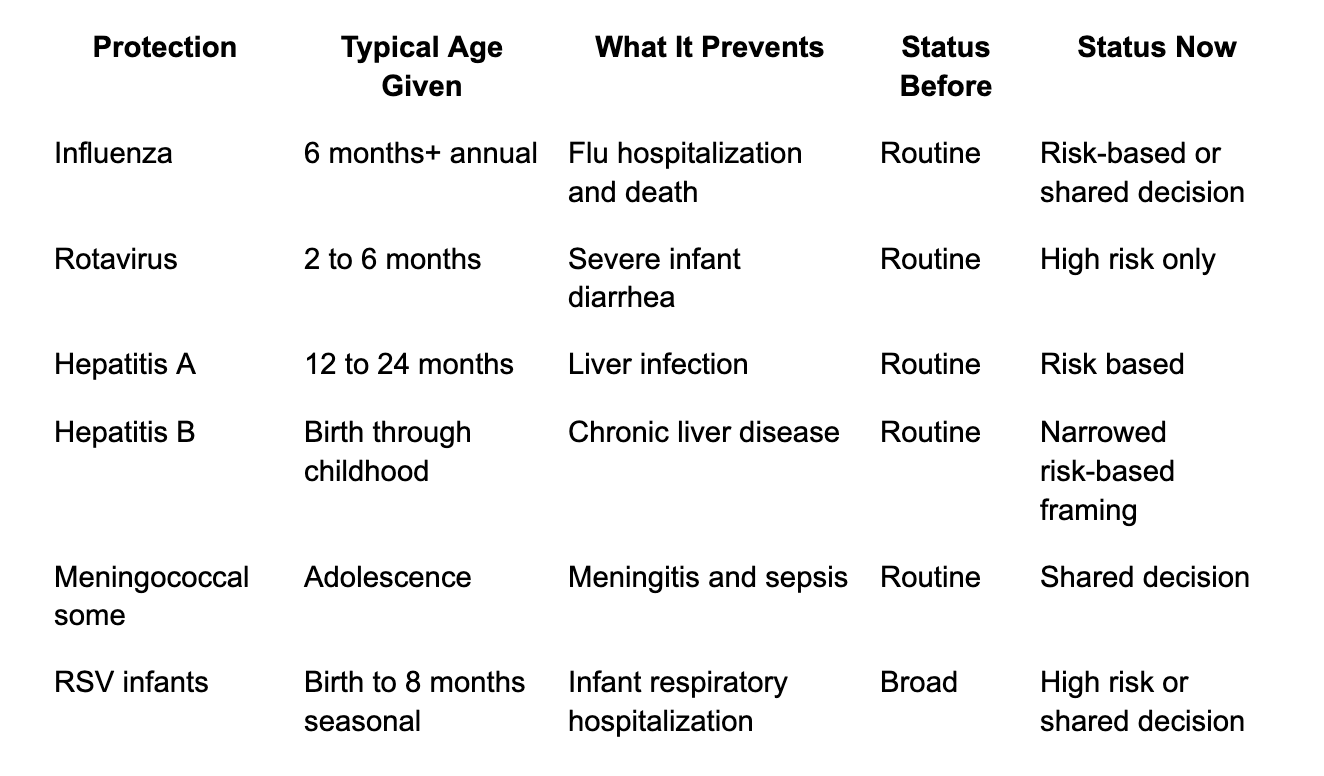
While these vaccines will still be available, once vaccines move out of the routine category, clinician recommendations soften, insurance coverage becomes easier to erode over time, and families with less consistent access to healthcare are more likely to miss needed protections.
It is important to emphasize that as of now, all vaccines on the Schedule remain classified as preventive benefits and are covered by both public and private insurance.
Why the Change?
This revision did not go through the regular CDC review process. Instead, it was signed via a decision memorandum by the Acting CDC Director, citing a presidential directive and an assessment comparing the U.S. Schedule to those of other countries.
According to reporting and public statements, career CDC scientists, the experts who normally evaluate evidence and guide vaccine policy, were not meaningfully involved. Respected professional groups, including the American Academy of Pediatrics, have said they were not consulted. No new safety or efficacy data was presented to justify the change.
The Administration framed the decision as an effort to align with peer countries and to move toward flexibility and informed consent.
Denmark was cited as a model the United States should emulate. But this comparison ignores the reality of a very different healthcare system. Denmark has universal healthcare supported by a strong primary care and public health infrastructure. That may be a system many Americans desire, but it is not the system we currently have. Basing U.S. vaccine policy on Denmark without Denmark’s healthcare system is not alignment with international best practice. It is faulty logic dressed up as evidence.
Taken together, these actions reflect a leadership philosophy that prioritizes personal skepticism over the established scientific process.
Why the Concern?
The concern is not about access today. It is about process, precedent, and predictable consequences.
First, the lack of scientific justification. No new data was presented to explain why long-standing routine recommendations suddenly required downgrading. When evidence has not changed but policy has, trust erodes.
Second, the precedent this sets. If vaccine guidance can be altered without transparent review, expert deliberation, or public explanation, the guardrails that protect evidence-based policy are failing.
Third, insurance vulnerability. While coverage remains intact today, routine recommendations provide the strongest protection against future erosion. Weaker classifications invite administrative barriers, inconsistent coverage, and quiet retrenchment.
Fourth, equity. Risk-based and shared decision-making frameworks work best in systems with universal access and continuity of care. In the United States, they reliably widen gaps. Families with stable care navigate complexity. Families without it fall behind.
Fifth, herd immunity. Routine vaccination protects communities by normalizing uptake. As defaults weaken, population-level protection erodes, often invisibly until outbreaks occur.
For Parents
A weaker federal recommendation does not mean a vaccine is unsafe or unnecessary.
Because federal guidance, state requirements, and clinical recommendations may not always align, it helps to track both what experts recommend and what your state is actually doing before meeting with your child’s pediatrician:
American Academy of Pediatrics (AAP): Parent-friendly immunization schedule
https://www.healthychildren.org/English/safety-prevention/immunizations/Pages/Recommended-Immunization-Schedules.aspxKaiser Family Foundation: State vaccine requirements for children
https://www.kff.org/state-health-policy-data/state-indicator/state-vaccine-requirements-for-children/
Take Action
Senator Bill Cassidy of Louisiana, a physician and chair of the Senate Health, Education, Labor, and Pensions Committee, supported Robert F. Kennedy Jr.’s confirmation after receiving explicit assurances that Kennedy would not alter the U.S. vaccine schedule or undermine CDC vaccine messaging. Cassidy has since said those assurances were violated.
Cassidy has also publicly described the changes to the Schedule as lacking scientific input and as undermining public confidence in vaccines. That matters because Cassidy is not a bystander. As chair of the HELP Committee, he is uniquely positioned to demand accountability.
While Cassidy represents Louisiana, his role as HELP Committee chair gives him national responsibility over public health policy. You do not need to live in Louisiana to contact his office.
Call Senator Cassidy’s Office:
U.S. Senate Office: (202) 224-5824
When you call, leave a brief message with a staff member or voicemail. Keep it short, respectful, and focused on accountability.
Sample message:
Hello, my name is _____. I’m calling to urge Senator Cassidy, in his role as chair of the HELP Committee, to hold formal oversight hearings on the recent changes to the CDC’s childhood immunization schedule. Senator Cassidy has said these changes lack scientific input and violate assurances made during Secretary Kennedy’s confirmation. I’m asking the Senator to use his authority to demand transparency, documentation, and accountability to restore public trust in vaccine policy. Thank you.
Sources:
1. U.S. Child & Adolescent Immunization Schedule
Centers for Disease Control and Prevention
https://www.cdc.gov/vaccines/schedules/hcp/imz/child-adolescent.html
2. Parent-Friendly Immunization Schedule
American Academy of Pediatrics
https://www.healthychildren.org/English/safety-prevention/immunizations/Pages/Recommended-Immunization-Schedules.aspx
3. Statement and Response to Schedule Changes
American Academy of Pediatrics: https://www.aap.org
4. State Vaccine Requirements for Children
Kaiser Family Foundation
https://www.kff.org/state-health-policy-data/state-indicator/state-vaccine-requirements-for-children/
5. CDC Vaccine Safety Monitoring and Review Process
Centers for Disease Control and Prevention
https://www.cdc.gov/vaccinesafety/index.html
6. Reporting on the Childhood Vaccine Schedule Change and Oversight Concerns
CIDRAP, University of Minnesota: https://www.cidrap.umn.edu
7. Senate HELP Committee Oversight Authority
U.S. Senate Committee on Health, Education, Labor, and Pensions: https://www.help.senate.gov